
The Path of the Belt: What Taekwondo Ranks Really Mean
One of the first things people notice when they enter a Taekwondo dojang is the variety of belt colors worn by students.
White belts move carefully through their first techniques.
Color belts train with growing confidence.
Black belts stand with quiet experience.
At first glance, the belt system looks simple. Different colors marking different stages of progress.
But in Taekwondo, belts are not simply rewards for learning techniques. They represent a journey. Each belt reflects lessons in discipline, perseverance, respect, and character that unfold over time, beginning in the earliest stages of training.
At TVMA Academy, the belt system is designed to guide students step by step through both physical training and personal development. Each level builds not only stronger technique, but a stronger person.
Why Taekwondo Uses a Belt System
The belt system exists to give structure to growth.
Without milestones, improvement can feel invisible. Students may train hard but struggle to see how far they have come. Belts help mark that progress while introducing new challenges and responsibilities.
Each stage of training develops different qualities:
Physical coordination and strength
Technical understanding
Mental focus and patience
Self-discipline and accountability
Confidence built through effort
Rather than rushing toward black belt, students move through a sequence of experiences that gradually shape both skill and character.
The belt system reminds us that mastery is built in stages.
The Meaning Behind the Word Taekwondo
Before exploring the belt journey, it helps to understand the art itself.
The word Taekwondo comes from three Korean words:
Tae – to strike or kick with the foot
Kwon – to strike with the hand or fist
Do – the way, path, or lifelong practice
Together they describe The Way of the Foot and the Fist.
But the word Do carries deeper meaning. It suggests a path of learning that continues long after techniques are mastered. Taekwondo is not simply about kicking and punching. It is a system of personal development guided by discipline, respect, and perseverance.
The TVMA Academy Belt Journey
At TVMA Academy, students progress through the following belt ranks:
White Belt
Yellow Belt
Orange Belt
Green Belt
Blue Belt
Brown Belt
Purple Belt
Red Belt
Deputy Black Belt
Black Belt
Each level represents new technical skills, deeper understanding, and greater responsibility within the training community.
But the belt itself is only a symbol.
The real transformation happens within the student.
The Kukkiwon and the Global Standard of Taekwondo
While many martial arts use colored belts, Taekwondo has a unique connection to an international governing body.
The Kukkiwon, located in Seoul, South Korea, serves as the World Taekwondo Headquarters. It establishes the official standards for Taekwondo training, poomsae, instructor education, and black belt certification recognized around the world.
Through the Kukkiwon, Taekwondo maintains a shared structure across countries and cultures. Students who earn Kukkiwon-certified black belts receive internationally recognized rank that reflects years of disciplined training.
This global framework helps preserve the traditions and technical standards of Taekwondo while allowing schools across the world to teach the art within their own communities.
At TVMA Academy, we honor this connection by teaching Kukkiwon-aligned curriculum and emphasizing both technical excellence and the values that define Taekwondo as a martial art.
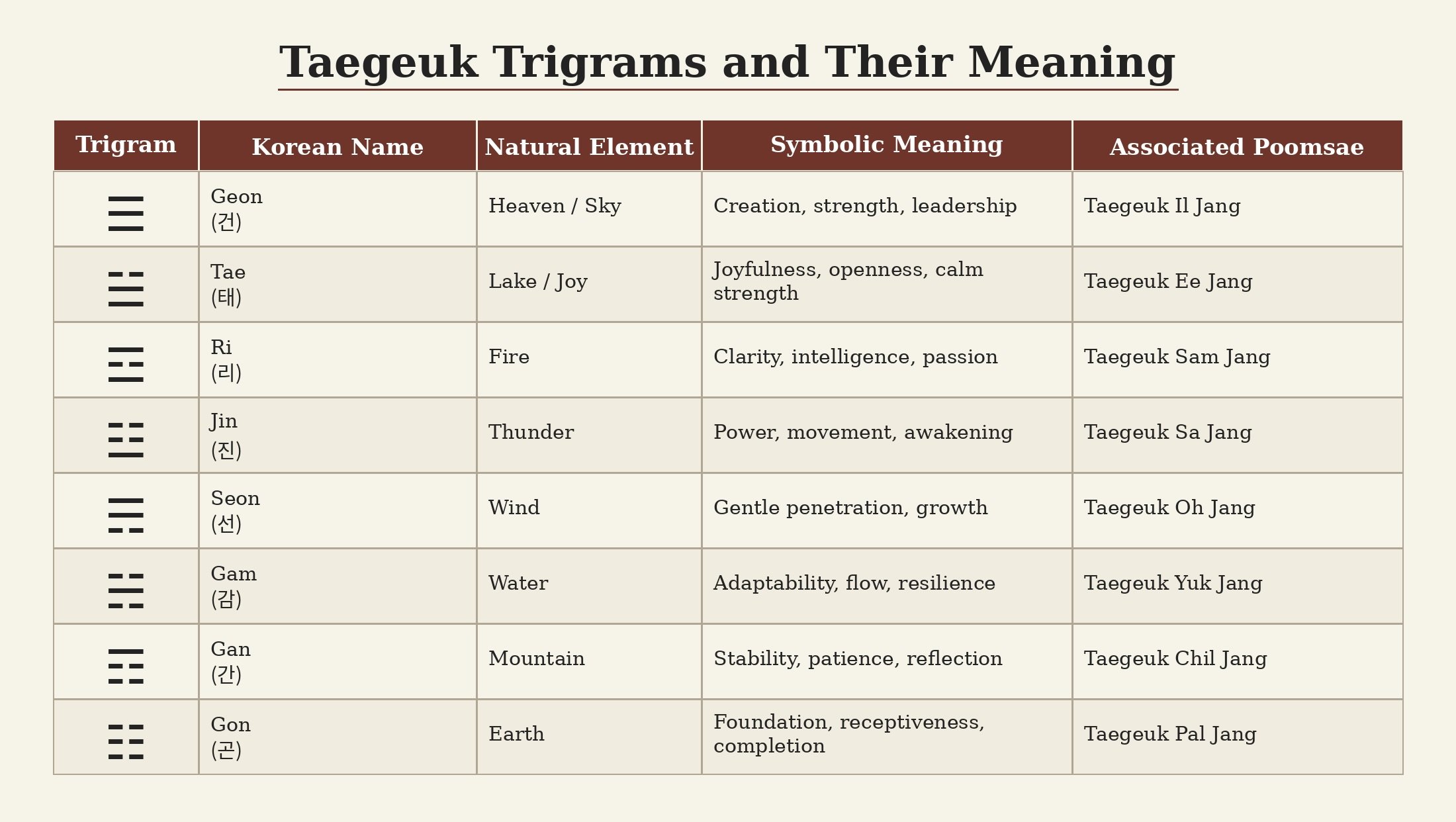
Taegeuk Trigrams and their meanings chart
White Belt – The Beginning
Every journey begins with uncertainty.
White belt represents a blank canvas. Students step onto the mat not yet knowing the movements, the terminology, or even how their body will respond to training.
At this stage, the first lessons are not about power. They are about respect.
Students learn the etiquette of the dojang, the meaning of bowing, and the importance of discipline. The value associated with this level is Chung, representing loyalty and dedication to family, teachers, and community.
This is where many students begin to understand that growth does not happen only in class, but through consistent effort outside of it.
Before strength comes respect.
Yellow Belt – Planting the Seed
Yellow belt represents the earth where knowledge begins to grow.
Students study Hyo, the principle of respect for parents and gratitude toward those who support their journey. As techniques improve, students begin to recognize the importance of responsibility in their training.
Progress at this stage often comes from simple consistency. Showing up. Listening carefully. Practicing even when movements still feel unfamiliar.
Growth begins quietly.
Orange Belt – Courtesy in Action
Orange belt introduces Yae, the value of courtesy.
Courtesy reminds students that martial arts skill must always be balanced by humility and kindness. Strength without courtesy loses its meaning.
At this level, techniques begin to feel more coordinated. Students deepen their understanding of poomsae and begin connecting movements into flowing sequences rather than isolated techniques.
The art begins to take shape.
Green Belt – Growth and Friendship
Green belt symbolizes growth.
Students focus on Wu-Ae, the value of kindness and friendship. They begin to understand that martial arts is not an individual journey alone. It is a shared experience built on encouragement and cooperation.
Training partners help each other improve. The dojang becomes a community where effort is respected and progress is celebrated together.
The trigram for this stage represents fire, symbolizing energy and passion while reminding students to control their emotions and actions.
As students grow, they begin to see that Taekwondo is not just an individual journey, but one built through shared experiences and support.
Blue Belt – Loyalty and Trust
At blue belt, students study Shin-Eui, representing loyalty and trust.
Trust is built through honesty, reliability, and integrity. Students learn that their actions affect the entire training environment.
Skill continues to grow, but character becomes increasingly important.
Brown Belt – Perseverance
Brown belt students focus on In-Nae, the principle of perseverance.
Training becomes more demanding. Techniques require greater precision and endurance. Students encounter challenges that test their patience and determination.
Perseverance teaches that progress is rarely immediate. True growth comes from continuing forward even when improvement feels slow.
This stage often reminds students that perseverance is not just about pushing forward, but about continuing even when the journey feels difficult.
This lesson often extends far beyond martial arts.
Purple Belt – Humility
Purple belt students study Gyeom-Son, the value of humility.
As skills become more advanced, humility becomes even more important. Students begin assisting others, offering encouragement, and recognizing that learning never truly ends.
The trigram associated with this stage represents water, reminding students to stay calm, adaptable, and persistent through challenges.
Humility keeps the mind open and the ego quiet.
Red Belt – Courage
Red belt represents Yong-Gi, the principle of courage.
Courage in Taekwondo does not mean aggression. It means doing the right thing even when it feels difficult.
Students at this level are preparing for the final stages before black belt. Training requires focus, discipline, and confidence built through years of effort.
Deputy Black Belt – Leadership
Before reaching black belt, students earn the rank of Deputy Black Belt.
This stage emphasizes leadership and reflection. Students begin mentoring others and representing the values of the dojang more visibly.
They study Gon, symbolizing the earth. It is a representation to consider the foundations. We often teach to remember training with beginner’s eyes.
Students often reflect deeply on their journey at this stage, recognizing how far they have come and how much they still have to learn.
Black Belt – A New Beginning
Many people believe black belt is the final goal.
In reality, it represents the beginning of deeper study.
A black belt is someone who has developed discipline, perseverance, and responsibility through years of practice. From this point forward, the martial artist continues refining technique, understanding philosophy, and supporting the next generation of students.
Many Taekwondo practitioners pursue Kukkiwon certification at the black belt level, connecting their training to the global standards of the art.
The journey never truly ends, and in many ways, earning a black belt is where deeper growth and understanding truly begin.
It simply becomes more meaningful.
If you are just beginning your journey, understanding the meaning behind each step can make the path more meaningful from the very start.
Reflection Question
What does your belt represent today?
Not just the techniques you have learned, but the habits you practice, the respect you show others, and the effort you bring to training.
If someone had never seen your belt, would they still recognize your dedication through your actions?
Frequently Asked Questions
How many belts are there in Taekwondo?
At TVMA Academy, students begin at white belt and progress through a structured series of color ranks before reaching black belt.
Each level represents growth in skill, discipline, and responsibility. While the exact number of belts may vary between schools, the purpose remains the same: to build a strong foundation step by step over time.
How long does it take to earn a black belt?
Most students train for several years before reaching black belt. Progress depends on dedication, consistency, and mastery of required skills.
Is black belt the highest rank?
Black belt is an important milestone, but it represents the beginning of advanced learning rather than the end of training.
Why do belts matter in martial arts?
Belts provide structure for learning, clear goals for students, and a way to measure both technical skill and personal development.
What do students gain from progressing through belts?
Students build discipline, confidence, physical ability, focus, and respect that extend beyond martial arts into everyday life.
